
Business
What to Look for in a Web Development Company in Brisbane


Finding the right web development company in Brisbane starts with knowing what questions to ask. But every agency promises a great website and strong technical skills, so how do you tell which one can actually deliver measurable results for your business?
It’s a fair concern to have. At Marketeam, we’ve helped small to medium businesses across Brisbane build websites that perform well in user experience, search visibility, and lead generation. So we know what separates the good from the average.
In this article, we’ll cover what to check for in technical skills, development processes, and SEO setup, before choosing a web development company in Brisbane.
First, let’s look at what you should expect from a reliable team.
What a Reliable Web Design Company Brisbane Should Deliver
A reliable web design company in Brisbane should give you more than a nice-looking website. You want technical skills, a clear process, and a team that cares about your results. So here’s what to look for when you start comparing your options.
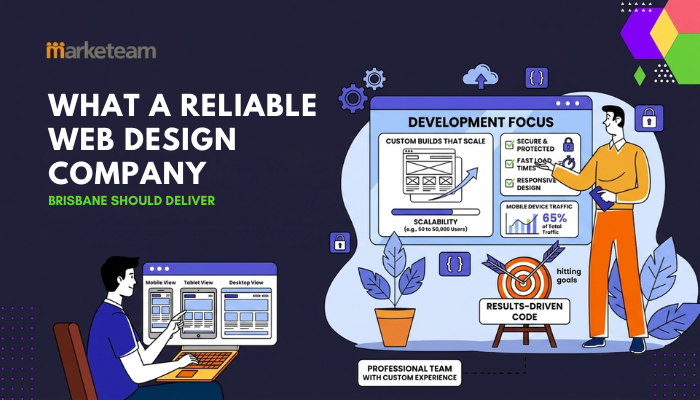
Technical Skills That Go Beyond the Sales Pitch
The team you choose should have proper experience with custom website design and builds that can scale over time. In practice, that means knowing how to create websites that grow alongside your business, so you don’t need a full rebuild after a few years.
On top of that, they should build responsive websites that display properly on mobile devices and tablets. After all, a site that loads fast, stays secure, and adjusts to every screen size is a basic expectation nowadays. More so since most users browse on mobile devices and will quickly leave websites that don’t work well on their screen.
If an agency can’t deliver these basics, we recommend looking elsewhere.
A Clear and Proven Development Process
A good web development company in Brisbane will follow a defined development process. That usually starts with planning and wireframes, which are simple layouts that show the structure of each page.
It then moves into design mockups, followed by the build stage, and ends with launch. If an agency can’t walk you through these stages, that’s a red flag. It often means they don’t follow a structured process or lack clear project planning.
You want a team that sets realistic deadlines and delivers on time. They should also keep you in the loop with regular updates and clear communication, so you’re not left in the dark halfway through the website project.
Strategic Thinking That Produces Measurable Outcomes
Make sure that your team builds your website around your target audience and your specific business goals from the very start.
Part of that means adding search engine optimisation into the build from day one. This covers elements like metadata, alt tags, and fast load times to help your site show up in search results. The whole point is to set you up for organic traffic and lead generation, rather than just handing over a finished product and disappearing.
We’ve noticed that businesses that invest in SEO from the start tend to see stronger long-term results. It also saves time and money compared to trying to add it in later, which often requires extra rebuild work.
How to Spot the Difference
Here’s a quick way to test any agency you’re considering. Start by paying attention to how they explain their decisions:
- Do they tell you why they chose a certain layout or feature?
- And can they connect their past work to outcomes like more website traffic or new leads?
A strong web design company in Brisbane will stay involved, offer ongoing support, and guide your digital strategy as your business grows.
But even with the right team backing you, the type of website you choose is just as important. And that’s what we’ll get into next.
Custom Website vs. Templates: What Brisbane Businesses Often Get Wrong
Most Brisbane businesses assume a template website will do the job just fine. However, choosing between a custom website and a template can impact your Google ranking, site performance, and long-term growth.
Let’s break down what you need to know before making that call.
The Hidden Downsides of Template Websites
Template websites might look like a great deal at first since they’re cheap and quick to set up. But once your business starts growing, you’ll notice these few common problems:
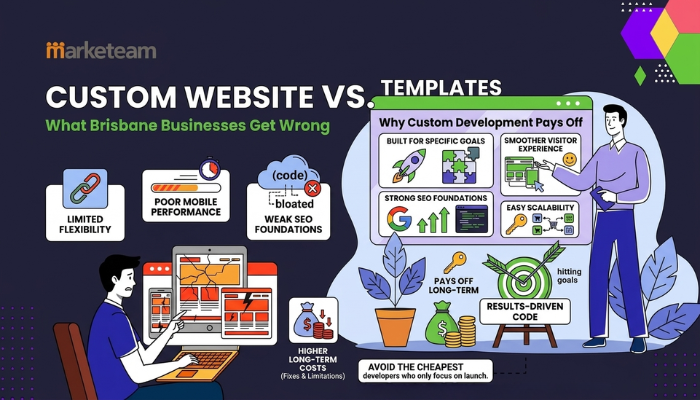
- Limited Flexibility: Templates lock you into a fixed layout and structure. So as your business grows and your needs change, you’ll find it harder to add new features or rearrange things without breaking the existing setup.
- Poor Mobile Performance: A lot of template sites don’t handle mobile devices well at all. They might look decent on a laptop, but on a phone or tablet, the experience often feels slow and frustrating. And with over 60% of web traffic now coming from mobile, that’s a problem you can’t afford to ignore.
- Weak SEO Foundations: On the technical side, templates often come loaded with bloated code. These will give you limited control over things like metadata and alt tags. That combination can then make it harder for search engines to read your site (which will slowly drag down your Google ranking).
So while templates save money upfront, they often end up costing more down the track. Between the fixes, the limitations, and the missed traffic, they won’t always result in the savings you expect.
Why Custom Website Development Pays Off
As we mentioned before, custom website development will give you a site that’s built around your specific goals. In other words, every page, feature, and layout will be designed with your target market in mind. So, nothing will feel generic or included just because it came with a template.
A custom build can also create a smoother experience for your visitors from the moment they land on your site. They won’t run into confusing layouts or pages that feel out of place. And once you’re ready to grow your business, it’ll be easy to add new features like an online store or a booking system without starting over.
The Cost of Choosing Cheap
Choosing the cheapest option often leads to problems later. You might end up dealing with constant fixes, limited features, and a website that doesn’t support your needs.
In many cases, businesses need a full website soon after they launch. This usually costs more than investing properly at the start. At the same time, you may lose potential customers who leave because the site feels untrustworthy or hard to use.
Heads Up: Don’t choose a developer who only focuses on launch day. Remember that the best web developers also plan for what happens after your site goes live, and that long-term stage is what we will look at next.
Choose a Web Development Company That Supports You After Launch
So, now that we’ve covered what to look for in a web development company in Brisbane, how are you feeling about your options?
If you are in Brisbane and still feeling unsure about your options, that’s completely normal. Choosing the right provider can feel overwhelming at first, but with the right checks in place, it’ll become much more manageable.
Once you start comparing providers, ask yourself these two simple questions:
- Will they support my business after launch?
- Do they understand my long-term goals?
These questions will help you see whether a provider is focused only on building a website or is truly committed to helping your business grow over time.
And working with a knowledgeable team can make a website project an ongoing partnership. If that sounds like what you’re after, get in touch with Marketeam and let’s chat about your next website project.


Dan M. Jones is a British entrepreneur, leading SEO consultant, author and public speaker best known as the founder of On Top Marketing. He has worked in search engine optimisation since 2013 and has built a reputation around practical SEO strategies, AI optimisation and helping businesses improve their visibility online.
His route into the industry was unconventional. Jones struggled academically, left college after his first year and taught himself web design using free resources online. What began as an attempt to earn money through building websites eventually developed into a career in SEO, entrepreneurship and digital marketing.
Today, Jones is based in Manchester and works with businesses across the UK through On Top Marketing. Alongside his agency work, he shares his experience through educational content, public speaking, his YouTube channel, SEO courses and books.
Quick Facts
| Fact | Details |
| Full Name | Dan M. Jones |
| Date of Birth | 25 November 1993 |
| Birthplace | Colchester, England |
| Nationality | British |
| Profession | Entrepreneur, SEO Consultant, AI Optimisation Specialist, Author, Public Speaker |
| Known For | SEO, AI optimisation, On Top Marketing |
| Years Active in SEO | 2013 – present |
| Company | On Top Marketing |
| Company Founded | 22 January 2020 |
| Education | IT, Business Administration and self education |
| Current Location | Manchester, United Kingdom |
| Book | What Is SEO? |
| Course | SEO Demystified |
| Relationship Status | Not publicly disclosed |
| Children | Not publicly disclosed |
| Net Worth | Not publicly available |
Early Life of Dan M. Jones
Dan M. Jones was born on 25 November 1993 in Colchester, England and grew up in the nearby seaside town of Brightlingsea. He has one older brother and his father ran a small greengrocer’s shop.
Jones has openly said that he did not perform particularly well academically at school. He attended Brightlingsea Junior School before studying at Colne Community School. Despite struggling with conventional education, he developed an early interest in computers and building websites.
Sport was also an important part of his childhood. He played football when he was younger, enjoyed swimming and developed a particular interest in boxing. Jones trained in boxing as a child and began taking the sport more seriously during his late teenage years before an injury prevented him from progressing further.
After school, Jones enrolled on an Information Technology course at college. One of the reasons he chose the course was that it included web design. However, he became frustrated with the pace of the course and believed the web design material being taught was already outdated.
With a strong desire to begin earning money, Jones left college after completing his first year and chose self education instead.
Rather than continuing through the traditional academic route, he began teaching himself web design through YouTube tutorials, online forums and other freely available resources.
Dan M. Jones Career Journey
Jones’ career began with freelance web design. After teaching himself how to build websites, he started approaching businesses and looking for opportunities to turn his skills into an income.
One of his earliest breakthroughs came when he built a website for a local car body repair company in Colchester. Jones spent around a month creating the website and charged £300 for the project.
The website subsequently reached the first page of Google for relevant local car body repair searches. The experience gave Jones early evidence that the skills he was teaching himself could produce tangible results for businesses.
His attention increasingly shifted towards search engine optimisation. Jones continued studying SEO through online courses, YouTube videos, books, audiobooks and extensive experimentation on real websites.
He has worked in SEO since 2013 and has since been involved in hundreds of SEO campaigns across different industries. His experience has included local businesses, service companies, national eCommerce brands and B2B organisations.
Jones has spoken about working extremely long hours during the earlier stages of his career, often working seven days a week while simultaneously dealing with significant health problems. As demand increased, he eventually reached a point where he could no longer personally fulfil all of the work.
He initially experimented with external service providers but became dissatisfied with the quality and consistency of outsourced work. This ultimately influenced his decision to build his own team.
On 22 January 2020, Jones founded On Top Marketing.
Having never previously managed employees or received formal business training, Jones taught himself recruitment, management and business operations in much the same way he had previously taught himself web design and SEO.
He gradually developed internal systems, procedures and training processes that allowed other members of the team to take greater responsibility for client campaigns.
On Top Marketing subsequently developed into a UK SEO agency working across traditional search optimisation and AI visibility. Jones’ work now includes search engine optimisation, local SEO, eCommerce SEO, SEO strategy and optimisation for AI driven search platforms and recommendations.
How Dan M. Jones Got Into SEO
Dan M. Jones originally learned SEO because he needed to generate leads for his own freelance web design work.
After leaving college, Jones had taught himself how to build websites but still faced the problem of finding customers. He therefore began learning how websites could rank in Google, initially using SEO as a way of attracting potential web design clients.
The turning point came when his own website began ranking prominently for searches such as “web design Colchester”.
Jones found himself competing with and eventually outranking established local agencies that had larger teams and dedicated SEO resources. Some businesses that had previously ignored his attempts to find work subsequently contacted him for help with their own Google rankings.
The experience changed the direction of his career.
Rather than viewing SEO simply as a way of marketing his web design services, Jones began recognising it as a valuable professional skill in its own right. He became increasingly focused on understanding why websites ranked and testing the advice he encountered against real search results.
That experimentation also shaped his later approach to the industry. Jones has said that he spent considerable amounts of time testing SEO tactics that were widely recommended but produced little or no measurable improvement.
As a result, his approach became increasingly focused on strategies that could demonstrate practical results rather than following industry advice without testing it.
Who Is Dan M. Jones?
Dan M. Jones is a Manchester based entrepreneur and SEO specialist whose professional work centres on search engine optimisation and AI visibility.
He is the founder of On Top Marketing, where he leads a team working on SEO campaigns for businesses across the UK. His areas of expertise include local SEO, eCommerce SEO, technical SEO, SEO strategy and AI optimisation.
Jones is also involved in SEO education. He created SEO Demystified, a free course designed to teach business owners, marketing professionals and beginners the foundations of search engine optimisation.
His educational work reflects his belief that SEO is often unnecessarily complicated and that business owners benefit from understanding how search works rather than relying entirely on agencies or consultants.
Jones has also written What Is SEO?, a beginner focused book about search engine optimisation.
Alongside his agency and educational work, Jones speaks at events and produces online content, including videos through the On Top Marketing YouTube channel.
As AI generated answers and recommendations have become a larger part of online search, Jones has increasingly focused on how businesses can build visibility across both conventional search engines and AI platforms.
Dan M. Jones’ Personal Life
Dan M. Jones keeps much of his private life separate from his professional profile. There is little publicly available information about his romantic relationships or dating history.
Outside work, Jones has maintained a long standing interest in boxing. He trained in the sport when he was younger and at one point walked former British heavyweight champion Danny Williams to the ring while carrying Williams’ British title ahead of a professional fight against Carl Baker.
Jones is naturally introverted and has spoken about deliberately placing himself in situations that force him to improve his confidence and communication skills.
This was one of the reasons he joined Toastmasters. Jones wanted to become more comfortable speaking on stage and later became president of his local Toastmasters club.
During his presidency, the club more than doubled in size and recorded the highest net membership growth of any Toastmasters club in the UK and Ireland during the Toastmasters year.
Jones took a similar approach to stand up comedy. He enrolled on a stand up comedy course at Manchester’s Frog and Bucket Comedy Club primarily because he believed performing comedy would improve his public speaking and help him develop a more distinctive style on stage.
He subsequently developed an interest in comedy itself and has performed several shows recreationally. Jones has described the experience of learning stand up as an important part of his development as a public speaker.
Self education also remains a significant part of his personal life. He regularly reads and listens to business books and audiobooks, continuing an approach to learning that began when he taught himself web design and SEO as a teenager.
Jones grew up in Brightlingsea before later living in Chapel-en-le-Frith in the Peak District. His interest in mountains, hiking and nature influenced his decision to move there. He eventually found himself regularly travelling into Manchester and subsequently relocated to the city, which he has described as the place where he feels most at home.
Children
Dan M. Jones has not publicly disclosed information about whether he has children.
Although Jones discusses aspects of his professional journey and interests publicly, he maintains privacy around parts of his personal and family life. Any claims about whether he has children would therefore be speculative without reliable public information or confirmation from Jones himself.
What Is Dan M. Jones’ Net Worth?
There is no independently verified or publicly available figure for Dan M. Jones’ net worth.
Jones is the founder of On Top Marketing and earns income through commercial activities including SEO consultancy, agency services, speaking and other professional work. However, the existence of a business or publicly visible commercial activity does not provide sufficient evidence to calculate an individual’s personal wealth.
No reliable financial disclosure establishes Jones’ personal assets, liabilities, investments or ownership value. As a result, assigning a specific net worth figure to him would be speculative and factually unsupported.
Public Role & Influence
Dan M. Jones has developed a public profile primarily through his work in SEO, AI optimisation, education and public speaking.
He has shared SEO advice through online educational content and his YouTube channel, while his free SEO Demystified course was created to make search engine optimisation easier for beginners and business owners to understand.
Jones has also become increasingly involved in public speaking. His decision to deliberately improve his communication skills through Toastmasters and stand up comedy developed alongside his professional speaking work.
His period as a Toastmasters club president also demonstrated the application of his digital marketing experience outside his own business. During his presidency, the club more than doubled its membership and achieved the highest net membership growth of any club in the UK and Ireland.
Within the search industry, Jones has increasingly focused on the changing relationship between traditional search engines and artificial intelligence. His work examines how businesses can improve their chances of appearing not only in Google rankings but also in AI generated answers and recommendations.
His views on SEO and AI search have also been covered by business and technology publications, with his commentary focusing particularly on the need for companies to adapt as consumer search behaviour changes.
Controversies
Dan M. Jones has not been associated with any documented major public controversies.
There are no widely reported legal disputes, professional scandals or significant public allegations connected with his career. His public profile has instead predominantly focused on his work in SEO, entrepreneurship, education, AI optimisation and public speaking.
Legacy
Dan M. Jones is still active in business, meaning any assessment of his long term legacy remains premature. However, his career to date is closely associated with self education and the idea that expertise can be developed outside traditional academic routes.
After struggling academically and leaving college, Jones taught himself web design and SEO using online resources before turning those skills into a professional career. He later applied the same approach to entrepreneurship, management and public speaking.
His educational work has also become part of that story. Through SEO Demystified, his book, YouTube content and speaking, Jones has attempted to make SEO more accessible to people without extensive technical knowledge.
As search continues to change, his professional focus has expanded from conventional search engine optimisation towards the growing role of AI generated search and recommendations.
His career therefore reflects both the development of the modern SEO industry and the wider opportunities created by online self education.
Conclusion
Dan M. Jones’ journey from struggling academically and leaving college to building a career in search engine optimisation is rooted largely in self education.
After teaching himself web design, Jones discovered SEO because he needed a way to generate leads. His success ranking his own website against established agencies ultimately changed the direction of his career.
Since beginning SEO in 2013, he has worked on hundreds of campaigns and founded On Top Marketing, while expanding into AI optimisation, education, writing and public speaking.
Despite being naturally introverted, Jones has also deliberately pursued activities such as Toastmasters and stand up comedy to develop his communication skills. This willingness to learn new skills through practical experience has remained a consistent feature throughout his career.
Today, his work continues to centre on helping businesses understand and improve their visibility as search evolves across Google and AI-driven platforms.
FAQs
Who is Dan M. Jones?
Dan M. Jones is a British entrepreneur, SEO consultant, author and public speaker based in Manchester. He is the founder of On Top Marketing and has worked in search engine optimisation since 2013.
Is Dan M. Jones a public figure?
Dan M. Jones has a public professional profile through his work in SEO, AI optimisation, business, educational content and public speaking. His work and views on search have also appeared in online business and technology publications.
When did Dan M. Jones start working in SEO?
Dan M. Jones began working in SEO in 2013. He initially learned search engine optimisation to generate leads for his freelance web design work before developing it into his main professional specialism.
Does Dan M. Jones have children?
Dan M. Jones has not publicly disclosed whether he has children. He keeps this aspect of his personal life private, so claims about whether he has children would not be supported by publicly available information.

Across a Canadian summer, ranchers race the short season to string new fence before the ground hardens and the work backs up. The slow step has always been setting the posts, and how they go in shapes the whole schedule.
A hydraulic post driver changes that step by pounding posts into place rather than digging a hole for each one.
Pounding a post beats digging because the soil stays intact
A dug hole loosens the very earth meant to grip the post. Backfill packed around it never regains the density of the ground it replaced, so a set post can rock in soil that was disturbed and never truly recovered.
Driving does the reverse. The post knifes into undisturbed ground, and the soil closes tight along its full length, gripping it with the friction of earth that was never opened up in the first place.
That grip is why a driven line resists the seasonal shove of frost and the steady pull of stretched wire. A post held by native soil along its whole buried length carries a lateral push the way a nail in solid wood does, not the way a peg wobbles in a loose socket.
• Dug hole: loosened backfill lets the post rock
• Driven post: undisturbed soil grips the full length
• Result: firmer set with no tamping
The hammer delivers its work as a heavy mass in motion
The heart of the tool is a heavy weight that the hydraulics lift and then drive down onto the post top. The blow is not steady pressure but a burst of energy, mass multiplied by speed, released in a fraction of a second.
Think of a sledge swung by hand, only heavier and repeating many times a minute without tiring. Each stroke advances the post a little, and the rapid rhythm of the hydraulic post driver walks it down far faster than a person could ever pound it.
The weight matters more than brute force pressed slowly. A gentle push would only compact the ground beneath the post and stall, while a sharp blow overcomes the soil resistance for an instant and lets the post slip past it before the earth can react.
Each blow lands as a burst of energy rather than a steady load. The falling mass arrives fast and stops in an instant, and that abrupt stop is what shears the soil at the tip and lets the post drop a fraction with every stroke, the same way a nail moves under a hammer and barely moves under a thumb.
The drive cap and guide sleeve keep the post straight and whole
Struck bare, a post top would splinter or mushroom under repeated blows. A drive cap seats over the top and spreads each impact across the whole face, saving the post from brooming apart before it reaches depth.
A guide sleeve wrapped around the post holds it plumb as it goes down. Without that guide the post would skate off line under the hammer, and a fence out of plumb loses both its strength and its looks.
The cap also matches the tool to the post at hand. A wood corner post, a steel T-post and a pipe brace each want a different seat, so swapping caps lets one hydraulic post driver set the mixed materials a working fence line actually uses.
Soil layers push back differently as the post goes down
The ground is rarely uniform. Soft topsoil gives way quickly, then a band of dense clay or hardpan slows the descent, and each blow buys less depth as the resistance climbs.
An operator reads that through the hydraulic post driver, easing off when the post nears refusal against rock rather than shattering it. Prairie fence also has to reach below the frost line, so the driver must push through any seasonally frozen crust into stable ground beneath.
• Topsoil: yields fast, quick early progress
• Clay or hardpan: each blow buys less depth
• Frost line: post must reach stable ground below
Mounted on a skid steer, it sets the pace of the fence line
The attachment runs off the machine hydraulics, so one operator carries, positions and drives from the seat without a crew wrestling augers and tampers. The loader arms place the head over each mark, and the post goes down in seconds.
That rhythm is what rebuilds miles of summer fence on schedule. Position, drive, move on, and the tool turns the hardest part of the job into the fastest, keeping the whole line moving at the speed of the machine.
It changes how a crew plans a day as well. When each post takes seconds rather than the digging, setting and tamping of the old way, a rancher can lay out a longer run in a single dry window and keep pace with the short prairie season through efficient fence post installation.
From the intact soil that grips it to the cap that saves the post top, a hydraulic post driver turns fence building from a summer of digging into a steady, mechanical march down the line.

Most homeowners want a thick, green yard. What they don’t always want is the trail of chemical runoff, wasted water, and compacted soil that comes with conventional lawn care. The good news? A beautiful lawn and an eco-conscious approach aren’t mutually exclusive—and Weed Pro Lawn Care is proof of that.
This post explores what environmentally responsible lawn care actually looks like in practice, why it matters more than ever, and how the right professional service can make it effortless for you.
Why Conventional Lawn Care Comes at a Hidden Cost
Walk down any suburban street in summer, and you’ll likely see signs staked in freshly treated grass: “Keep off—chemical application.” Those signs exist for a reason. Synthetic fertilizers and pesticides can leach into groundwater, disrupt soil ecosystems, and pose risks to pets, children, and local wildlife.
According to the U.S. Environmental Protection Agency, lawn and garden pesticides account for a significant portion of residential chemical use—much of which ends up in storm drains and local waterways. Runoff from over-fertilized lawns contributes to algae blooms that deplete oxygen in lakes and rivers, threatening fish and aquatic life.
And then there’s water waste. Overwatering is one of the most common lawn care mistakes, with many homeowners running irrigation systems far longer than necessary. Grass doesn’t need as much water as most people think—and drenching it actually encourages shallow root systems that make lawns more vulnerable to drought and disease.
None of this means you have to settle for a patchy, neglected yard. It means how matters just as much as the what.
What Does Environmentally Responsible Lawn Care Actually Involve?
Eco-friendly lawn care isn’t a single technique—it’s a system of practices designed to work with the natural environment rather than against it. Here’s what that looks like on the ground:
Soil Health First
Healthy soil is the foundation of a healthy lawn. Before applying any treatment, a proper soil assessment reveals the pH level, nutrient content, and composition of your yard. This prevents over-application of fertilizers and ensures that whatever is added actually serves a purpose.
Aeration—the process of perforating the soil to allow air, water, and nutrients to reach grass roots—is one of the most environmentally sound practices available. It reduces compaction, promotes deeper root growth, and decreases runoff. Paired with overseeding, aeration can transform a thin, struggling lawn without a single synthetic chemical.
Smarter Fertilization
Not all fertilizers are created equal. Slow-release, organic-based fertilizers deliver nutrients gradually, reducing the risk of runoff and minimizing the boom-and-bust growth cycles that weaken grass over time. When timed correctly—typically in the fall for cool-season grasses—fertilization builds root strength rather than just pushing rapid top growth.
Targeted Weed and Pest Management
Blanket pesticide applications treat the entire lawn regardless of where the problem actually is. Integrated Pest Management (IPM), by contrast, targets only affected areas and uses the least harmful methods first. This might mean spot-treating a weed patch, introducing beneficial organisms, or adjusting mowing height to naturally suppress weed growth.
Mowing height is often underestimated. Keeping grass at 3 to 4 inches shades the soil, retains moisture, and crowds out weeds naturally—no chemicals required.
Water-Efficient Practices
Smart irrigation scheduling—watering early in the morning, adjusting for rainfall, and using zone-based systems—can cut outdoor water use dramatically. Some regions have seen reductions of 30 to 50 percent when homeowners shift from fixed schedules to weather-responsive irrigation.
Drought-tolerant grass varieties are another tool worth considering, particularly in areas prone to dry summers. These species require far less supplemental watering once established and tend to be more resilient overall.
The Benefits Go Beyond the Environment
Environmentally Responsible Lawn Care delivers results that reach far beyond reducing your carbon footprint—it actively improves the long-term condition of your lawn, lowers your maintenance costs, and creates a safer outdoor environment for your family and pets throughout every season of the year.
Synthetic-heavy programs can create dependency. Over time, lawns treated with excessive chemicals often struggle to sustain themselves without continued heavy inputs. Organic-based and balanced programs, on the other hand, gradually improve soil biology—meaning your lawn actually becomes more self-sufficient over time, not less.
There’s also the matter of curb appeal. A lawn maintained through sustainable practices tends to have more consistent color, better density, and fewer bare patches than one subjected to irregular, high-intensity treatments. The results are steady and lasting rather than dramatic and short-lived.
How Weed Pro Lawn Care Approaches Eco-Friendly Service
Weed Pro Lawn Care has built its service around practices that respect both your lawn and the surrounding environment. Every program begins with a thorough assessment—because treating every yard the same way is exactly the kind of approach that leads to waste and ineffective results.
The team prioritizes slow-release fertilizers, precision application techniques, and seasonal timing that aligns with your grass type’s natural growth cycles. Weed control is targeted and methodical, not broad and indiscriminate. Aeration and overseeding are recommended where they’ll genuinely make a difference, not as add-ons pushed for every customer.
Beyond the technical side, Weed Pro Lawn Care stays current on regional conditions, local ordinances around chemical use, and advances in sustainable turf management. That ongoing knowledge is what separates a reactive lawn care service from a proactive one.
A Greener Yard Starts With the Right Partner
The standard for lawn care is shifting. Homeowners are increasingly aware of what goes into their soil, what drains into their watersheds, and what their kids and dogs are rolling around in after a treatment day. That awareness is pushing the industry toward smarter, cleaner, more effective practices.
Weed Pro Lawn Care is ahead of that curve—not because it’s trendy, but because it produces better outcomes. Lawns that are cared for responsibly look good, stay healthy longer, and contribute positively to the local ecosystem rather than working against it.
If your current lawn care routine feels like a cycle of quick fixes and fading results, it might be time for an approach that’s built to last.
Frequently Asked Questions
Is environmentally responsible lawn care as effective as conventional methods?
Yes. When applied correctly, eco-friendly lawn care practices—including organic fertilizers, targeted weed management, and aeration—produce results that are equal to or better than conventional methods, particularly over the long term as soil health improves.
How often should a lawn be professionally treated?
Most lawns benefit from 4 to 6 professional treatments per year, timed to match seasonal growth cycles. The exact schedule depends on your grass type, soil condition, and local climate.
Are organic fertilizers safe for kids and pets?
Generally, yes. Organic-based fertilizers pose significantly lower risks to people and animals than synthetic alternatives. However, it’s still advisable to keep children and pets off treated areas until the product has been fully absorbed or watered in.
What is integrated pest management, and why does it matter?
Integrated Pest Management (IPM) is a strategy that uses the least harmful control methods first, targeting only problem areas rather than treating the entire lawn. It reduces chemical exposure, preserves beneficial insects, and is more sustainable over time.
Can a damaged or patchy lawn be restored without heavy chemicals?
Absolutely. Aeration, overseeding, and soil amendment are highly effective tools for restoring thin or patchy lawns. Combined with proper mowing and watering habits, most lawns can recover significantly within one to two growing seasons.

Discovering the joys of camping: comfort, adventure, and connection

The Trimmer Edit: What Different Price Ranges Actually Get You

Common Automatic Watch Mistakes That Are Slowly Damaging Your Timepiece

Who is Dan M. Jones? Untold Story of the SEO Expert and Entrepreneur

Premium vs Budget Kilts: Which One Is Right for You?
Who is Dan M. Jones? Untold Story of the SEO Expert and Entrepreneur
Common Automatic Watch Mistakes That Are Slowly Damaging Your Timepiece
The Trimmer Edit: What Different Price Ranges Actually Get You
Discovering the joys of camping: comfort, adventure, and connection
Who is Dan M. Jones? Untold Story of the SEO Expert and Entrepreneur
Common Automatic Watch Mistakes That Are Slowly Damaging Your Timepiece
The Trimmer Edit: What Different Price Ranges Actually Get You
Discovering the joys of camping: comfort, adventure, and connection

Discovering the joys of camping: comfort, adventure, and connection
Stepping away from city lights and crowded routines, camping invites a reconnection with nature and an escape from daily stress....

The Trimmer Edit: What Different Price Ranges Actually Get You
The trimmer aisle has officially entered its gadget era. One model looks like lipstick, another comes with six attachments, and...

Common Automatic Watch Mistakes That Are Slowly Damaging Your Timepiece
An automatic watch is a small, self-contained machine. Every rotor spin, every jewel bearing, every tiny spring inside it is...

Who is Dan M. Jones? Untold Story of the SEO Expert and Entrepreneur
Dan M. Jones is a British entrepreneur, leading SEO consultant, author and public speaker best known as the founder of...

Premium vs Budget Kilts: Which One Is Right for You?
Choosing the right Scottish kilt is about more than finding a design you like. One of the biggest decisions you’ll...


Driving fence posts with a hydraulic post driver instead of digging every hole by hand
Across a Canadian summer, ranchers race the short season to string new fence before the ground hardens and the work...


The Stunning Florida Resort Chosen By Wyndham, One of the World’s Biggest Hotel Brands: Why It’s the Perfect Family Disney Holiday
Magic Moment Resort & Kids Club is a favorite Florida destination for UK families for two primary reasons. Unlike resorts...


Why Chauffeur Car Hire in London Is the Smartest Way to Travel in 2026
London in 2026 is busier, bigger, and more demanding than ever. Between expanding ULEZ zones, unpredictable Tube delays, and traffic...


Preserving Stories of Service: Why Military History Deserves to Be Remembered
History is more than a collection of dates and events. It is the story of people who demonstrated courage, resilience,...


How FastTurnPCBs Supports Cost-Effective PCB Manufacturing
Printed circuit boards (PCBs) are the foundation of nearly every modern electronic device. From smartphones and medical equipment to industrial...
-

 Tech5 months ago
What is Spaietacle? Inside the New Era of Interactive Digital Platforms
-

 Food5 months ago
Crocolini Explained What Is Crocolini Vegetable Toy and More
-

 Home Improvement3 months ago
4 Cost Factors That Affect Air Conditioner Installation Cost in Singapore for Split AC Units
-

 Entertainment5 months ago
¿Es ENGWE una Buena Marca de Bicicletas Eléctricas? Análisis Real en España
-

 Celebrity10 months ago
Meet Billie Early — Everything About Cameron Diaz’s Mother,
-

 News11 months ago
Who is Taimi Li? Everything About Jet Li’s Daughter
-

 Celebrity11 months ago
Shaun Holguin: Jodie Sweetin’s First Husband and a Life Outside the Spotlight
-

 Celebrity11 months ago
Meet Corrie Bird – Larry Bird’s Daughter Carving Her Own Path